| Step closer to understanding Big Bang |
| Friday, 17 October 2008 | |
University of Otago
Researchers have revealed for the first time that
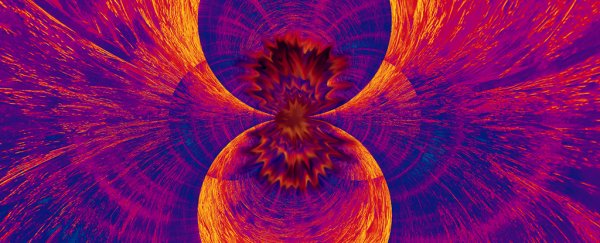
quantum whirlpools can spontaneously form in ultracold matter, a finding that could help them understand how the Big Bang formed the universe. Image: iStockphoto Discovering exactly how the Big Bang created the universe may be a step closer – thanks to the combined efforts of physicists from opposite sides of the world. Experimental physicists from the University of Arizona worked with theoretical physicists from the University of Queensland Dr Ashton Bradley (now a Research Fellow at the University of Otago) and Dr Matthew Davis to determine how Bose-Einstein condensates (BECs) form. Their findings are a world first and appear in the prestigious scientific journal, Nature. A Bose-Einstein condensate is a state of matter formed at ultra-cold temperatures, where atoms behave like waves. It was first predicted by Einstein in 1924; Bose was a young Indian physicist who used the theory to explain certain behaviours of light. Its practical implications are still not fully appreciated, but the development of "atom lasers" may advance the production of nanotechnology and it may also have applications for super-powerful "quantum computers". Dr Bradley says scientists have been able to make vortices – alignments of atoms forming rotating whirlpools within the otherwise stationary atoms of the BEC – by stirring BECs. But, until now, they had only suspected that vortices may form spontaneously under the right conditions. For years, physicists have speculated about the possibility of vortices being created as a BEC is born. "Many people still thought that vortices would not be formed spontaneously, because vortices are quite energetic compared to the ground state of the system." The Arizona-Queensland collaboration has been able to show that vortices spontaneously appear between 25 to 50 per cent of the time. "We know that the vortices are a consequence of critical fluctuations occurring as the gas cools, becoming a superfluid Bose-Einstein condensate." Dr Bradley says that, by quantifying the occurrence of vortex formation in BECs, physicists understand a little more about the behaviour of the atoms in other phase transitions, such as the emergence of structure in the universe after the Big Bang. "A generic feature of trapped, ultra-cold Bose gases is controllability and repeatability of experiments. Coupled with first principles theory, this makes for very fruitful scientific study." "A feature of our study is that, while similar concepts have been studied in other systems, they are typically much more difficult to understand and characterise. In our system, we can study spontaneous vortex formation and quantitatively compare experiments with relatively simple theory." "It's something people have been trying to understand for a long time. This is the first time anyone has seen vortices forming spontaneously during the birth of a BEC." The paper can be viewed here. Editor's Note: Original news release can be found here. |