ScienceAlert Homepage

TOP JOBS:
The shining - astronomers find our universe is twice as bright
Swinburne University of Technology   
Sunday, 04 January 2009
universe.jpg
We’ve known for a long time that there is dust in
galaxies – we just didn’t appreciate the extent of its
influence.”
Dr Alister Graham

Astronomers have torn aside an enshrouding veil of dust to reveal that the universe is twice as brilliant and fiery a place as we had previously imagined.

In one of those profound discoveries that can shift our perception of the universe, an international team of astrophysicists has demonstrated that there is double the amount of light in the universe than previously thought, but that half of it is masked by clouds of interstellar dust.

The discovery, founded on a 10-year survey of some 10,000 galaxies, has been published in Astrophysical Journal Letters.

“At first we thought that we must have made a mistake,” Dr Graham says. “However, we were able to check the result by studying how the light-obscuring dust glowed in the infrared when heated by the starlight. This thermal glow, invisible at optical wavelengths, gave us the confirmation we needed.

“It is rather poetic that, in order to appreciate the full glory of our universe, we first had to appreciate something as small as the particles of dust that obscure it.”

Professor Simon Driver, from the University of St Andrews in Scotland, says the discovery means astronomers can now better understand the effect dust is having on their observations and correct for it, giving a more accurate appraisal of what is taking place.

The dust originates from material blown off by stars, like exhaust fumes, as they mature. Mixed in the wind from these stellar furnaces are particles of silicate and graphite, which build up in galactic clouds and trap the starlight, inhibiting its escape from a galaxy.

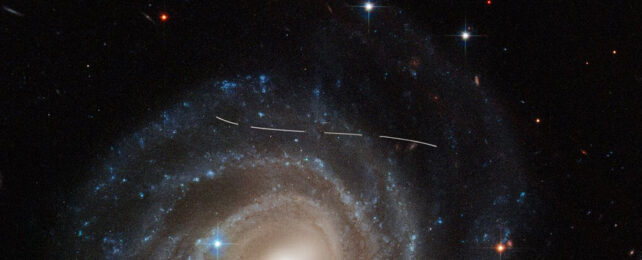
In making their discovery, the team first measured the brightness of a huge population of disc-shaped spiral galaxies with different orientations – face-on, edge-on and in between – to try to work out how much dust they contained. The idea is that galaxies seen face-on will appear brighter because, on average, there is less dust lying between their stars and the viewer. In contrast, the majority of stars in edge-on galaxies are shaded by dust such that only the facing outer rim of stars is seen.

From comparisons with a computer-simulated model of a dusty galaxy, the team determined how much light was actually escaping from the thousands of different galaxies in their survey sample. By measuring the infrared glow of the dust itself, which is heated by the absorbed starlight, they were also able to confirm how much energy was not escaping in the form of visible light – providing an accurate energy balance for the galaxies and thus our universe.

“The survey also enabled us to determine that our universe contains some 20 per cent more mass in stars than we had previously realised,” Dr Graham adds.

Dust changes the colour of a galaxy – making it appear redder. Given that both the brightness and the colour of a galaxy are used to convert its observed stellar flux into a stellar mass, this colour adjustment accounts for why 100 per cent more stars were not reported, even though the galaxies are twice as bright at blue wavelengths. 

The team says that although their research indicates the universe is more dusty, the total mass of the dust remains relatively tiny (well below one per cent) compared to everything else, and therefore does not cancel out the belief that there is still a great deal of enigmatic ‘dark matter’ in galaxies.

However, there are billions of distant stars in the disc of our galaxy, the Milky Way, that we cannot see because they are obscured by dust as we look sideways through the dusty galactic plane. The researchers say that the night-time band of light that is our galaxy would indeed be brighter if not for this dust.

The research was carried out through a global collaboration between the University of St Andrews, Swinburne, the University of Central Lancashire, Liverpool John Moores University, the Max Planck Institute and the European Southern Observatory. 


A story provided by Swinburne Magazine. This article is under copyright; permission must be sought from Swinburne Magazine to reproduce it.
 

Advertisement

Advertisement

hidden image hidden image hidden image hidden image